Independently published
Libro: Quant Basics 101: A Beginner's Guide To Quantitative Trading
Libro: Quant Basics 101: A Beginner's Guide To Quantitative Trading
No se pudo cargar la disponibilidad de retiro
| Formato | Tapa Blanda |
| Número de páginas | 485 |
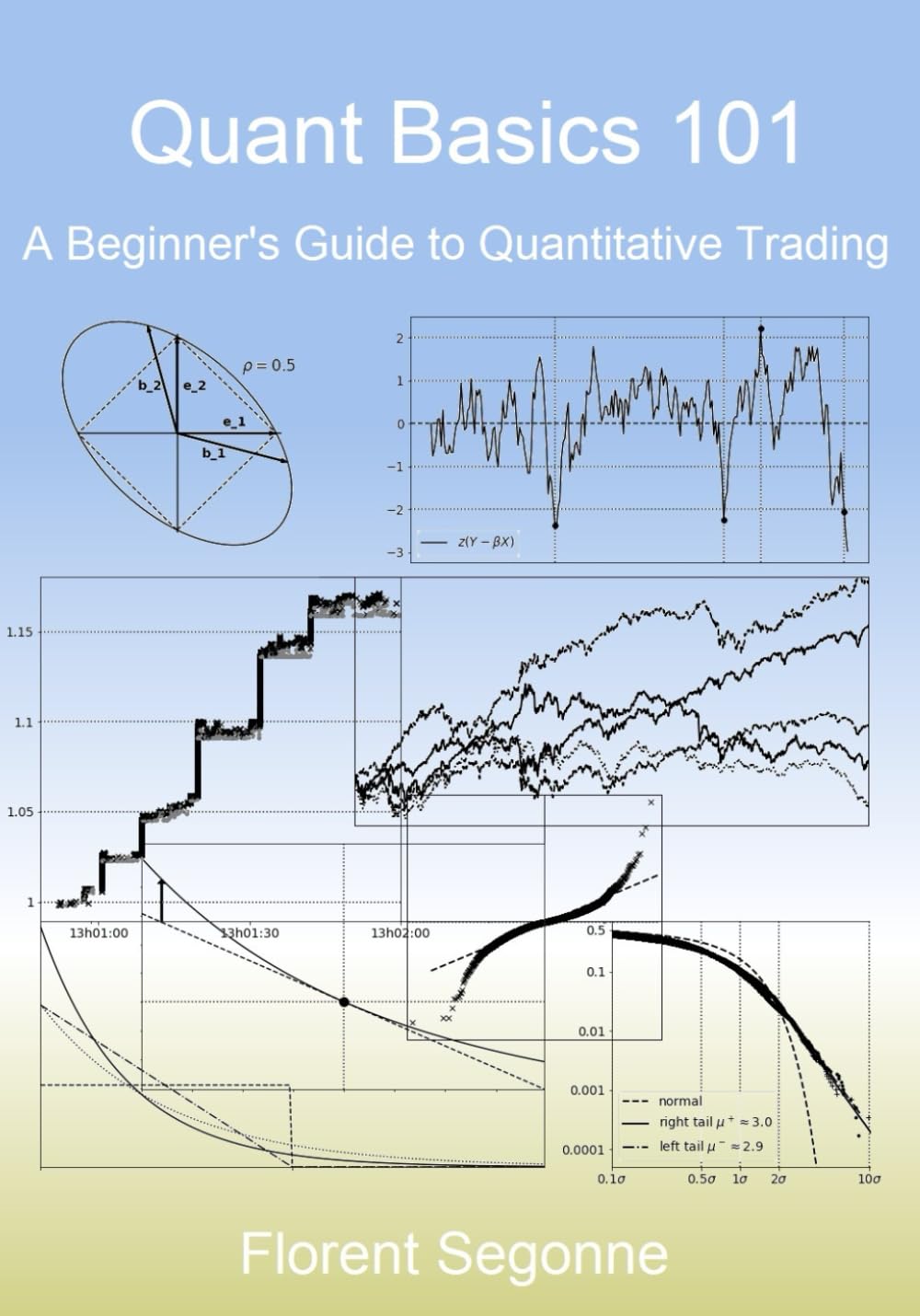
Quant Basics 101 is designed primarily for students interested in pursuing a career in quantitative trading and/or sell-side researchers exploring the buy-side. It is not aimed at retail traders, though they may find some useful insights.
Quantitative Trading uses a combination of mathematical and statistical models, algorithms, and computational methods to systematically analyze financial data, identify trading opportunities, and automatically execute trading strategies.
Sitting at the intersection of high-level math, intricate analytics, and advanced technology, quantitative trading has a reputation for being a difficult subject, demanding a dedication understood only by ardent financial and tech aficionados.
The book serves as a foundational guide to understanding the principles of quantitative finance: it teaches the essential habits to prevent common errors and avoid obvious mistakes; it offers guidance on how to approach some standard problems; it describes a few elementary examples of quantitative strategies and pinpoints several interesting areas of research. The book deals with the building blocks of quantitative trading. At its core, the book is about Building Intuition.
Primary themes discussed in the book are the research, design, backtest, and implementation of quantitative strategies, including the portfolio construction problem, the importance of risk management, and the danger of overfitting. Other themes include the acquisition of data, standard linear techniques, fixed-income theory, and the trading of volatility.
The book serves as a reference and source of ideas and intuition for quantitative traders, portfolio managers, risk managers, financial economists and regulatory professionals, amongst others, as well as researchers in related areas.
Table of Contents Preface
Notations
Lecture Guide
1. Toy Example(s)
1.In Doubt, Just Follow The Past 2.Discussion and Fixes 3.Variants: Trend-Following, Fund Replication, Equi-Vol 4.Changing Perspective 5.Interpretation: Algebraic Digression 6.Take-Aways
2. Back to Basics: Good Practice and Usual Mistakes
1.General Concepts and Notations 2.Constructing a Valid Backtest 3.Matters of Variances and Covariances 4.Execution: Fees, Slippage, Market Impact 5.Capital Requirement and Margin-to-Equity 6.Different Regions, Different Currencies 7.Good Practices and Take-Aways
3. (Over) Fitting is (Too) Easy
1.Inference and the Curse of Over-fitting 2.On the Maximization of Sharpe Ratios 3.Danger in the Numbers 4.Perspectives and Take-Aways
4. Everything (Almost) is Linear
1.Convolutions Everywhere 2.On the Equivalence of Standard Indicators 3.Linear Regressions 4.Linearity in Practice 5.Take-Aways
5. Risk Factor Models
1.Introduction 2.Standard Historical Models 3.Residuals, Betas, and the Hedging of Factors 4.Constructing Risk Models 5.Take-Aways
6. Portfolio Construction
1.General Concepts 2.Some Allocation Paradigms 3.Risk Factor Models and Portfolio Construction 4.Signal Prediction and Aggregation 5.Take-Aways
7. Data
1.Futures 2.Stocks (and Indices, ETNs, ETFs, Cryptos) 3.Options
8. A Taste of Fixed Income
1.Spot Rates, Discounting Curves, Forward Rates 2.Interest Rate Instruments: Futures and Swaps 3.Bond Basics
4.Carry
9. Stochastic Curve Models
1.Stochastic Curve Models 2.Stochastic Curve Models versus Spot Models 3.Application: the Schwartz-Smith Approach 4.Take-Aways
10. Beyond Black-Scholes
1.The Black-Scholes Paradigm 2.Variance: Replication and Properties 3.Volatility Stylized Facts 4.Quantitative Trading of Volatility 5.Take-Aways
11. Final Worlds
Appendices
A. The Basics of Algebra
B. On Models
C. Clustering
D. Risk Neutral Pricing
E. Random Proofs
References
Share
Provetodo - provedor integral
🇨🇱 Chile: Duble Almeyda 5595, Of. 904, Ñuñoa, Santiago
🇵🇪 Perú: PEFRED S.A.C, Chancay 32, San Juan de Lurigancho, Lima 1542
+56991709189
© 2026 Provetodo. Todos los derechos reservados.